
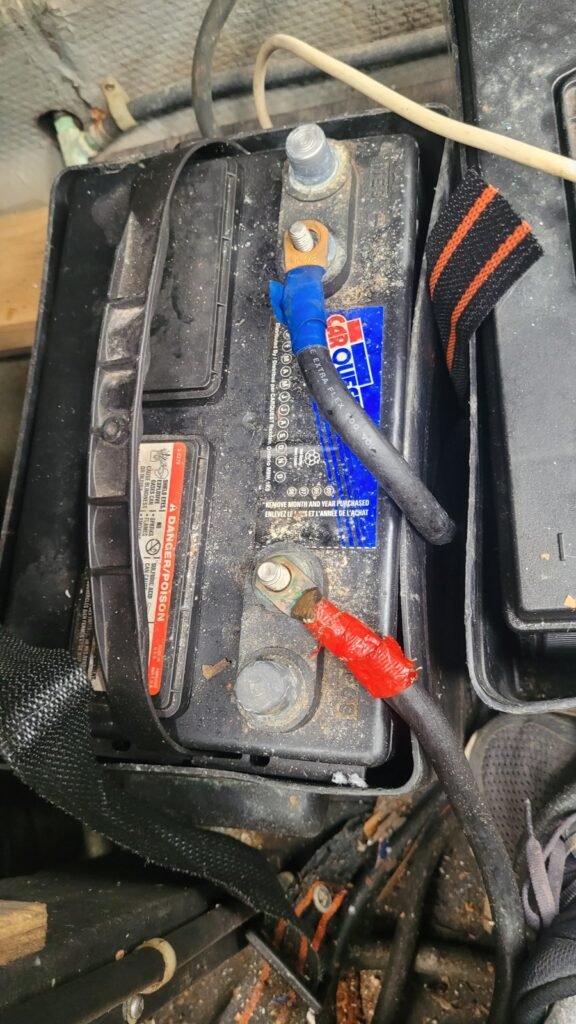
A while back I opened the battery compartment on my free 33-foot Chris-Craft and found what I can only describe as an archaeological site: corroded terminals, crusty connections, and wires that had clearly seen things. So I learned how to clean boat battery terminals properly. This post covers what that crust is, the gear you need, and the basic clean-up sequence, plus the point where you stop and call a professional. Learn from my bilge, not yours.
Rookie disclaimer: I’m not an electrician. Batteries can burn you with acid, short out with a lot of current, and give off flammable gas. If anything is swollen, leaking, cracked or melted, or you’re not sure what a wire does, stop and call a marine electrician. Follow your battery maker’s instructions and your boat’s manuals.
What boat battery terminal corrosion actually is
That fuzzy white, blue-green or crusty buildup is corrosion. It’s mostly the product of the terminal metal reacting with battery acid vapour and moisture, and boats are basically moisture with a hull. Corrosion adds resistance, which can mean slow cranking, dim lights, charging trouble and connections that heat up. It’s also a sign that something (a loose clamp, a leaking cap, an old battery) could use attention.
Safety gear and setup before you touch anything
- Eye protection and gloves. Battery acid and your eyeballs are not friends.
- Ventilation. Lead-acid batteries can give off hydrogen, especially while charging. Open the hatches, don’t smoke, and keep sparks away. On a gasoline boat, also make sure there are no fuel vapours in the bilge. Transport Canada’s Safe Boating Guide tells gasoline-boat operators to run the compartment blower for at least 4 minutes right before starting a gasoline engine for exactly this kind of reason.
- Turn everything off. Switch the battery selector and all loads off, and disconnect any shore charger.
- No metal jewellery. A ring across a terminal and a ground makes an impressive (bad) heater.
- Tools: insulated wrenches, a battery terminal brush, a plastic tub, baking soda, water, rags and a phone camera.
How to clean boat battery terminals, step by step
- Take photos first. Get every cable, every terminal and every label in the shot. Boats often have more than one battery and more than one wire on each post, and spring-you won’t remember which goes where.
- Disconnect the negative (–) cable first, then the positive (+). Taking the negative off first lowers the chance of a short if your wrench touches metal.
- Inspect the battery. Is the case cracked or bulging? Is there leaking acid or a strong rotten-egg smell? If so, stop. That battery needs a professional and probably a recycling depot.
- Neutralize and scrub. Mix baking soda into water and brush it onto the terminals and clamps. Fizzing is the acid being neutralized. Use the terminal brush to scrub the posts and the inside of the clamps until you see bare metal. Keep the mixture out of the battery cells (don’t open the caps).
- Rinse lightly and dry thoroughly. Wipe with a damp rag, then a dry one. Don’t hose down your bilge.
- Check the cables. Corrosion that creeps under the insulation, green crumbly wire or cracked lugs means the cable needs replacing, not cleaning.
- Reconnect positive (+) first, then negative (–). Tighten the clamps snugly. Don’t overtighten.
- Protect the terminals. A thin coat of terminal protector spray or dielectric grease on the outside of the finished connection helps keep moisture off.
- Secure the battery. It should be strapped or boxed so it can’t slide around, with the positive terminal covered.
🔋 Want the whole electrical picture? Battery & Basic Electrical for Rookies covers corrosion, terminals, battery types, basic wiring, and how not to electrocute yourself, all in plain English. See the Rookie Guides →
Preventing boat battery terminal corrosion
- Keep the terminals clean, dry and tight, and check them at the start and end of every season.
- Keep batteries charged. Follow the maker’s instructions for storage and charging.
- Make sure the battery box or compartment is ventilated and that the batteries are strapped down.
- If corrosion comes back quickly, ask why. A loose clamp, overcharging or an aging battery are all candidates.
When to call a pro
Call one if there’s swelling, leaking, melted insulation, burnt smells or mystery wiring, or if your “simple cleanup” turns into rewiring. Do the same if you’re dealing with lithium batteries, inverters or anything you don’t understand. On my boat, the wiring is on the “ask a pro” list. Cleaning terminals is a rookie job. Redesigning a 12-volt system is not.
FAQ
What’s the best way to clean corroded boat battery terminals? A common method: with safety glasses and gloves on and the battery disconnected (negative first), neutralize the corrosion with baking soda and water, scrub with a terminal brush, wipe dry, reconnect (positive first) and apply a terminal protector. Always follow your battery maker’s guidance.
Is the white stuff on battery terminals dangerous? It can contain acid residue, so keep it off your skin and out of your eyes, and wear gloves and eye protection. Heavy corrosion can also signal a leaking or failing battery.
Which battery cable do I disconnect first? Negative first, then positive. When you reconnect, do it in reverse: positive first, then negative.
Can I use Coke to clean boat battery terminals? People do, but it leaves sticky sugar behind in your bilge. Baking soda and water neutralizes the acid and cleans up more easily.
Make your batteries less historical than mine
Clean terminals are step one. Battery & Basic Electrical for Rookies goes further: what to replace, what to test, and when to hand it to an electrician. Check the Rookie Guides →, or get the free battery cheat sheet at Free Resources.
Want proof you survived the battery box? The Rookie Captain shop has tees and mugs for captains who learn things the hard way.
Reference: Transport Canada, Safe Boating Guide (TP 511E) and Maintaining a safe pleasure craft.
Leave a Reply