
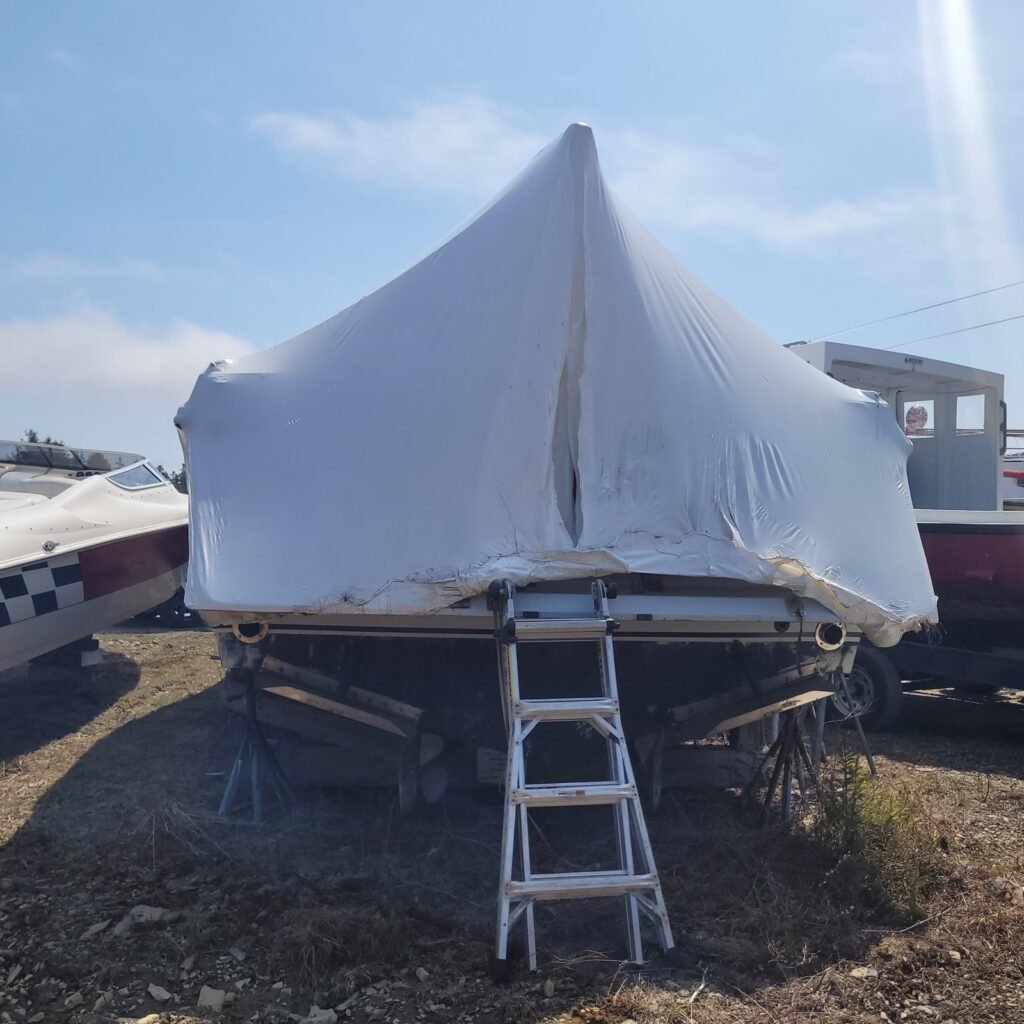
If you’ve typed how to winterize a boat with inboard motor into Google at 11 p.m. while the forecast threatens frost, welcome. Pull up a bucket. I’m James, I own a free, stripped-down 33-foot Chris-Craft with twin 350 MerCruisers, and until recently I thought “fogging” was something that happened to my glasses. My engines are straight inboards: each one turns a shaft that runs out through the bottom of the hull to a propeller. There’s no outdrive hanging off the back. This is the beginner-friendly overview I wish I’d had. The exact steps for your engine and transmission live in their manuals, so please don’t skip those.
Rookie disclaimer: I’m a beginner documenting what I’m learning, not a marine technician. Engines, transmissions and drain systems differ by model and serial number. Follow your Mercury/MerCruiser owner’s manual and your transmission maker’s manual, or have a qualified marine mechanic do the job. A cracked block costs a lot more than a winterization service.
Why winterizing an inboard boat matters (for beginners)
Water expands when it freezes. If lake or sea water is sitting in your engine block, exhaust manifolds or hoses when the temperature drops, it can crack them. That’s the scary, expensive part. The quieter damage comes from stale fuel, acidic used oil sitting in the crankcase, and rust.
Mercury says this plainly in its winterizing guide. That guide is written for sterndrives, so I’m only borrowing the engine parts of it. Used oil holds “acidic combustion byproducts” that can harm internal parts during storage, and “it is very important to displace all water from the cooling system.”
An honest note about my own boat: the engine tag says MerCruiser 260, 350 cubic inches (here’s the tag hunt), and neither engine has run in years. This season I’m learning the process, not taking a victory lap.
The rookie’s inboard winterizing order of operations
Treat this as a map, not turn-by-turn directions.
1. Change the engine oil and filter
Mercury recommends changing the oil and filter before long-term storage even if you didn’t use the boat much. Warm oil drains better, so the engine is usually run up to temperature first. That requires cooling water. On an inboard on land, that means a proper water supply to the raw-water intake, as your manual describes. Never run the raw-water pump dry, because it can wreck the impeller. (Wondering how much oil? I’m working on a MerCruiser 260 oil capacity cheat sheet (link goes live when that post is published).)
2. Stabilize the fuel
Mercury’s advice is to add fresh fuel (ethanol-free if you can get it) treated with a marine stabilizer such as Quickstor. If you have an older boat with a vented fuel tank, fill it to about 95% to limit condensation and leave room for the fuel to expand. Then run the engine about 10–15 minutes so the treated fuel gets through the system (Mercury: How to Store Your Boat for Winter). Mercury also says MPI fuel-injected engines need a special fuel/stabilizer/oil mix, while carbureted and older fuel-injected engines don’t. Check which you have.
3. Drain the raw-water side, then protect it
This is the step that matters most.
- Raw-water (seawater) cooled engines pull lake or ocean water straight through the block and manifolds. Closed-cooled engines keep coolant in the block, but the heat exchanger, manifolds and coolers still carry raw water, and that side can freeze too.
- Safety first. Mercury’s manuals warn that water can enter the bilge when the drains are open. The boat should be out of the water, or the seacock closed with the bilge pump working, and the engine must never run with the drains open. The boat should also sit as level as possible so everything drains. That’s from Mercury’s MerCruiser 8.1 H.O. owner’s manual (90-899883273, “Draining the Seawater System”). That’s a different engine from mine, so check your own manual for its wording.
- Find every drain point. MerCruiser drain systems vary by model. Mercury’s draining instructions list a “7 point manual drain system” for carbureted 5.7L inboards, and other models use single-point or 3-point systems. Older engines may differ again. Your manual has the diagram.
- Make sure each drain actually flows. A drain hole clogged with rust or scale can look empty while water sits behind it. TeamAM’s freeze-protection guide suggests gently clearing each hole with a stiff wire until water runs and stops.
- Protect the raw-water side. Mercury requires propylene glycol antifreeze, with a rust inhibitor and recommended for marine engines, in the seawater section for freezing temperatures or storage. Mix it to the antifreeze maker’s instructions (Mercury FAQ). Don’t use automotive antifreeze in the raw-water circuit. On closed-cooled engines, also check the coolant’s freeze protection.
- Don’t forget the raw-water strainer and intake hose. Water hides in them.
🛟 Stuck halfway through a long-stored boat? I’m putting everything I learn into Recommissioning an Old Cruiser, a plain-English guide to getting a neglected boat back toward the water, step by step. See the Rookie Guides →
4. Transmission fluid: follow the transmission maker
On an inboard, the gearbox (the marine transmission between the engine and the shaft) is usually a separate component, often made by a company other than Mercury, such as Borg-Warner/Velvet Drive or ZF/Hurth. That’s an example, not a claim about my boat; I haven’t identified my transmissions yet. Fluid type, level check and change interval all come from the transmission maker’s manual, so find the tag on the gearbox and go from there. If the fluid looks milky, that can mean water got in. Have it looked at before storage.
5. Shaft log and packing gland (stuffing box)
Follow the propeller shaft from the transmission to where it leaves the hull. That’s the shaft log, sealed by either a traditional stuffing box (packing gland) or a dripless shaft seal.
- Inspect it: look for corrosion, cracked or aging shaft log hose, and rusty hose clamps (BoatTEST: drivetrain components every inboard owner should inspect).
- Don’t just crank it tighter. BoatTEST explains that packing hardens and wears. If you keep tightening the gland to stop drips, the packing can eventually score the shaft, and then the shaft needs replacing too. Replacing the packing on a schedule is the cure.
- Dripless seals often get cooling water from a small hose off the raw-water circuit, so that line needs to drain or get antifreeze along with the rest. Check the seal maker’s instructions.
- If the boat stays in the water, Lowe Boats’ winterizing checklist says to close the seacocks, check the stuffing boxes for leaks, and keep checking on the boat.
6. Strut, cutless bearing and propeller check
Haul-out is the easiest time to look at the running gear. The strut is the bracket under the hull that holds the shaft, and the cutless bearing is the rubber-lined bearing inside it. Practical Sailor suggests wiggling the shaft in the cutless bearing to feel for play, and checking the prop for damage, pitting or discoloration that might point to an electrolysis problem. How much play is acceptable is a judgment call for a mechanic, so note anything that feels loose and ask. Lowe also suggests cleaning props, shafts, rudders and struts if the boat is stored out of the water.
7. Fogging, batteries and the rest of the boat
- Fogging: This protects the cylinders from rust. Carbureted and fuel-injected engines are handled differently, so follow your manual.
- Batteries: Disconnect them, keep them charged and store them as the manual suggests. (Old batteries can go very wrong; see Battery Archaeology.)
- Everything else that holds water: Freshwater plumbing, the head and the washdowns all need draining or antifreeze. Remove the hull drain plugs and raise the bow slightly (Mercury boat storage guide). Mine’s already shrink-wrapped like a giant leftover, so I’m ahead on one thing.
DIY or mechanic? An honest rookie’s take
If your engines run, you have the manuals and you’ve watched someone do it once, DIY inboard winterizing is very doable. Mine haven’t run in years: you can’t warm up the oil or pull antifreeze through an engine that won’t start. So this year I’m leaning toward hiring it out and watching. Bring coffee. Take notes for next year.
FAQ
Is winterizing an inboard different from winterizing a sterndrive? The engine steps are similar: oil, fuel, draining the raw-water side, antifreeze. An inboard has no outdrive. Instead you have a separate transmission, a shaft log with a packing gland or dripless seal, and a strut and cutless bearing to check.
What antifreeze goes in an inboard’s raw-water cooling system? Mercury requires propylene glycol antifreeze with a rust inhibitor, recommended for marine engines and mixed to the maker’s instructions. Closed-cooling systems also need their coolant checked for freeze protection.
Do I need to change the transmission fluid before winter? It depends on your transmission. The fluid type and change interval come from the transmission maker’s manual, not the engine manual. Milky fluid can mean water contamination and should be checked by a pro.
Should I tighten my stuffing box for winter? Don’t just crank it down. Inspect the packing and shaft log hose, and replace hardened packing instead of over-tightening, which can score the shaft. If the boat stays in the water, check the stuffing box for leaks.
Get the full rookie recommissioning playbook
Winterizing is half the story. The other half is spring, when you find out whether you did it right. Recommissioning an Old Cruiser walks through bringing a long-stored boat back toward the water. Browse the Rookie Guides →, or grab the free checklists at Free Resources.
And for the long off-season, a warm hoodie from the Rookie Captain shop makes the boatyard visits a lot more pleasant.
Sources: Mercury Marine, How to Winterize Your MerCruiser Sterndrive (engine and fuel sections only), How to Store Your Boat for Winter, Service & Support FAQs; MerCruiser 8.1 H.O. Owner’s Manual 90-899883273, “Draining the Seawater System”; Mercury MerCruiser cooling system draining instructions; BoatTEST; Practical Sailor; Lowe Boats winterizing checklist; TeamAM. Always defer to your engine and transmission manuals.
[…] because used oil holds acidic combustion byproducts (Mercury winterizing guide). More in my inboard winterizing walkthrough (link goes live when that post is […]