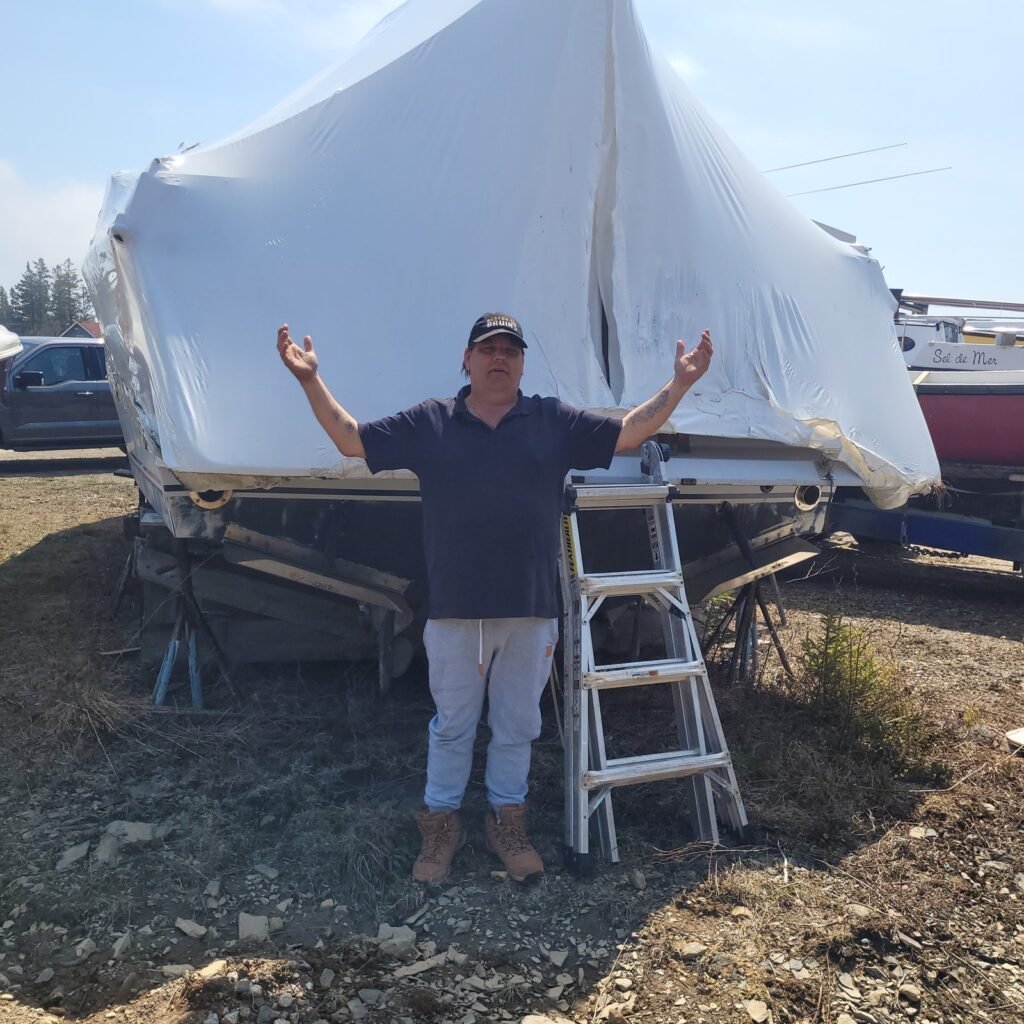
Somebody asked me, “Want a free boat?” and I said yes before my brain caught up with my mouth. That’s how I became the owner of a fully stripped-down 33-foot Chris-Craft with twin 350s and zero boating experience (the full origin story is here). This first time boat owner checklist is everything I should have looked at before I said yes. Whether your boat is free, cheap or suspiciously “just needs a little work,” run through it first.
Rookie disclaimer: I’m a beginner, not a marine surveyor. For any boat you’re seriously considering, especially an older cruiser, a professional marine survey and a mechanic’s inspection are worth every penny.
The first time boat owner checklist (the short version)
- Who owns it, and can you prove it?
- What is it, exactly? Find the make, model, year and engine tags.
- Hull and deck: soft spots, cracks, rot.
- Engines: do they run, and when did they last run?
- Batteries and wiring: is it crusty, corroded, or a mystery?
- Is everything there? Parts, hardware, manuals.
- Where will it live? Storage, hauling and yard fees.
- Canadian paperwork: licence or registration, and the operator card.
- Safety gear: what’s required for your boat’s length.
- The real budget: “free” is a price, not a cost.
Now the long version, with my mistakes as a free bonus.
1. Ownership and paperwork
Before anything else, make sure the person giving you the boat can actually give it to you. Ask for the bill of sale, any old licence or registration, and the receipts. In Canada, most pleasure craft with motors of 10 hp (7.5 kW) or more need a Pleasure Craft Licence (unless the boat is registered), and you have to update the licence when ownership changes. Transport Canada explains how on its Pleasure Craft Licence page.
Separately, anyone operating a motorized pleasure craft in Canada needs proof of competency, usually the Pleasure Craft Operator Card (Transport Canada: PCOC). The card goes with you, not the boat. Get it early. It’s the cheapest thing on this list.
2. Figure out exactly what it is
“It’s a Chris-Craft” got me about 10% of the way there. Find the hull identification number and the engine tags. My tag says MerCruiser 260, 350 cubic inches, and I found it wedged between hoses wearing a fine layer of grime. The exact model and serial number decide which manual, parts and specs apply. As for my boat’s year and model, I’m still hunting for the brochure.
3. Hull and deck
Walk the deck and feel for soft or spongy spots. Look for cracks, blisters, rot around hardware and signs of water where water shouldn’t be. If it’s on stands, look at the bottom too. A surveyor can sound the hull and use a moisture meter. You and your sneakers cannot.
4. Engines
Ask the question every rookie forgets: “When did it last run?” “Years ago” is an answer, and it’s mine. An engine that hasn’t run in years isn’t necessarily dead, but it’s an unknown, and unknowns cost money. If you can, have a mechanic do a compression check before you commit.
⚓ Want the printable version? My First-Boat Buyer’s Checklist turns all of this into a walk-around you can take to the boatyard, with the questions to ask and the red flags to watch for. See the Rookie Guides →
5. Batteries and wiring
Open the battery compartment. If the terminals are wearing a fuzzy white-and-green sweater, that’s corrosion, and it tells you something about how the boat was looked after. Mine were historical. Old boat wiring can be a fire risk, so if it looks like spaghetti that’s seen things, budget for an electrician.
6. Is everything actually there?
This is my personal lesson. The previous owner started a rebuild and never got to the putting-it-back-together part. My boat “came with everything except the parts. And some of the parts. In boxes. Somewhere.” The cockpit is a parts graveyard under shrink wrap. If a boat is disassembled, inventory it before you accept it, and photograph everything.
7. Storage, hauling and the yard
A 33-foot boat doesn’t fit in the driveway. Ask where it’s sitting now, what that costs, whether you can stay and how you’d move it. Hauling, stands, shrink wrap and launching all have price tags.
8. Required safety gear
What you have to carry depends on the boat’s length. For a boat over 9 m and up to 12 m (mine, at 33 ft, is just over 10 m), Transport Canada’s Safe Boating Guide (TP 511E) lists, among other things: a lifejacket or PFD for each person, a lifebuoy and a heaving line, flares (or an approved electronic alternative), an anchor with enough cable, bilge pumping, a sound-signalling device, navigation lights, a magnetic compass, a radar reflector and a 10BC fire extinguisher. I break the whole list down in my boat safety checklist post (link goes live when that post is published), but the official guide is the final word.
9. The real budget
“Free” covers the hull. It doesn’t cover batteries, engine work, safety gear, storage, insurance, the licence transfer or the tools you’ll suddenly need. Write down a number before you say yes, then double it. (Not official advice. Just scar tissue.)
First time boat owner tips I learned the hard way
- Say “let me think about it.” It’s a magic phrase. I didn’t use it.
- Bring a friend who knows boats. Bring snacks for them as payment.
- Take a boating course, even before you own a boat. Transport Canada lists accredited course providers.
- Document everything. Future you will thank present you, and the internet will laugh with you.
FAQ
What should a first time boat owner check before buying? Check ownership and paperwork, the exact make, model and engine serial numbers, the hull and deck condition, whether the engines run, the batteries and wiring, and whether all the parts are there. For older boats, get a professional survey.
Do I need a licence to drive a boat in Canada? Operators of motorized pleasure craft need proof of competency, usually the Pleasure Craft Operator Card. Separately, most boats with motors of 10 hp or more need a Pleasure Craft Licence or registration. Transport Canada’s website has the details.
Is a free boat worth it? Sometimes. The boat is free, but the repairs, storage, safety gear and paperwork aren’t. Run the checklist and build a budget before you accept.
What safety equipment does a new boat owner need? It depends on the boat’s length and type. Transport Canada’s Safe Boating Guide (TP 511E) lists the required gear for each size class.
Don’t make my mistakes (make new ones)
If you’re about to say yes to a boat, take the First-Boat Buyer’s Checklist with you. It’s everything above, printable, plus the questions I wish I’d asked. Get it on the Rookie Guides page →, or start with the free checklist at Free Resources.
And if you need something to wear while you crawl around a boatyard asking awkward questions, the Rookie Captain shop has tees and mugs made for exactly that stage of boat ownership.
Leave a Reply